Strength & Conditioning: A Critical Window for Youth Bone Development
How Multidirectional Movement and Strength Training Shape Lifelong Bone Health
When we think about kids’ sports, we often focus on performance, confidence, and teamwork. But one of the most powerful — and lasting — benefits of physical activity during childhood, especially during puberty, is its impact on bone health.
Puberty represents a finite window where the body is uniquely primed to build bone mass that will determine skeletal health for decades to come.
Bones Are Extra Responsive During Puberty
Throughout childhood, bones are constantly growing and adapting. During puberty, however, bone enters what researchers describe as a “growth-first” state. Hormonal changes dramatically increase how responsive bone tissue is to mechanical loading — meaning the forces placed on the body through movement matter more now than at any other time in life.
Research shows:
-
Peak bone mass gain occurs around 12–13 years in girls and 14–15 years in boys
-
Approximately 40% of adult bone mass is gained during the four years around peak height velocity
-
Nearly 95% of adult bone mass is established within a few years after puberty
Once this window closes, the opportunity to meaningfully increase bone mass is greatly reduced. Bone can be maintained later in life — but building it becomes much harder.
Why Multidirectional Movement Matters
Bones respond best to high-impact, multidirectional forces — the kinds of forces that challenge the skeleton in different directions and planes.
Sports that involve:
-
Jumping
-
Landing
-
Cutting
-
Sprinting
-
Rapid deceleration
provide a strong signal for bones to grow stronger and denser.
This is why activities like gymnastics, soccer, volleyball, basketball, and martial arts consistently demonstrate higher bone-loading effects than repetitive, straight-line activities like steady-state running.
Variety matters. Bones adapt most when loading is dynamic, unpredictable, and progressively challenging.
Strength and Conditioning: A Universal Bone-Building Tool
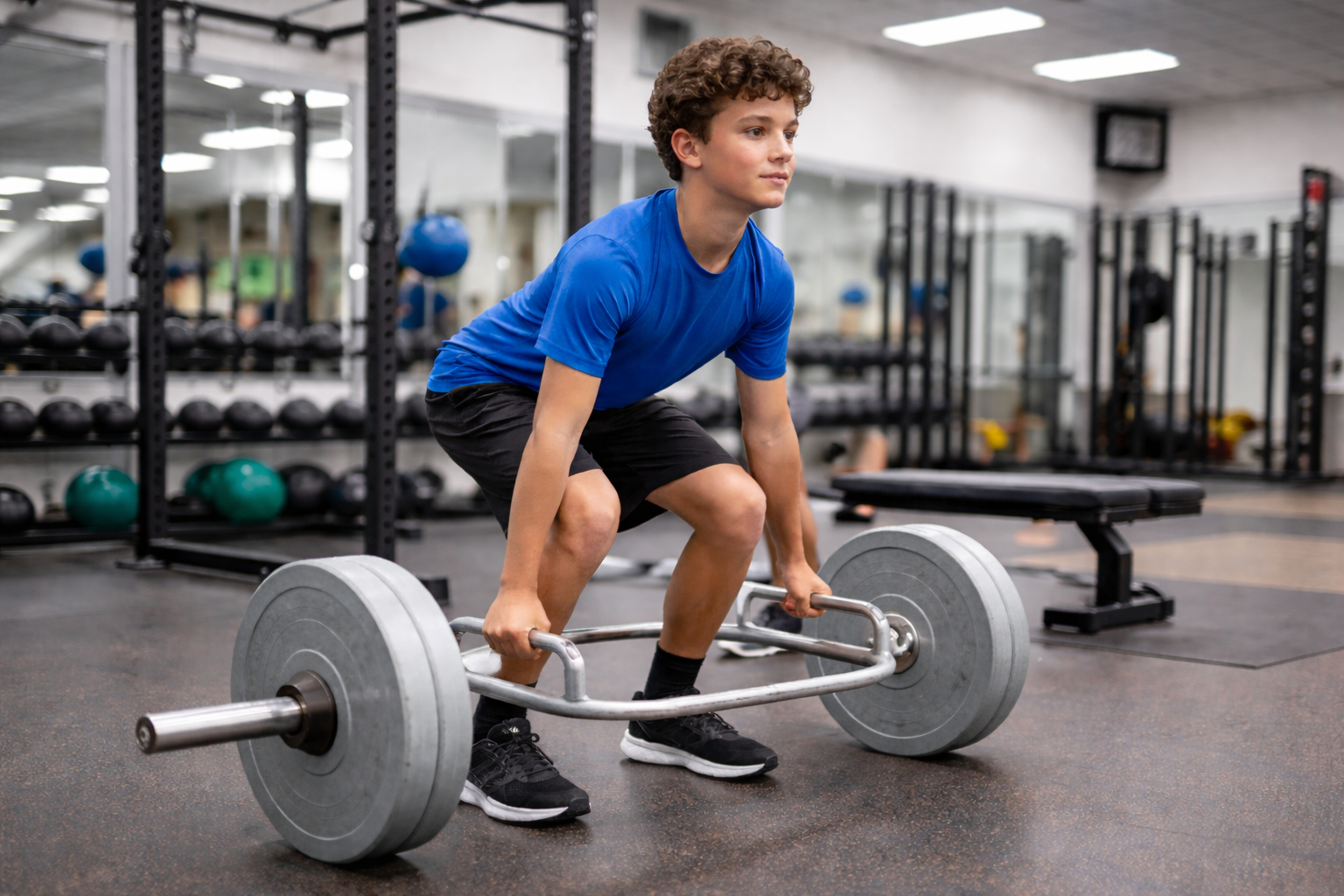
Here’s the key point: strength and conditioning can help all kids build bone mass — regardless of the sport they play, or even if they don’t play one at all.
Well-designed programs introduce the exact stimuli bones need during puberty:
-
Jumping and landing mechanics
-
Plyometrics (hops, bounds, skips)
-
Resistance training that loads the skeleton
-
Multidirectional movement and controlled deceleration
Importantly, research shows that bone responds quickly and efficiently to loading. It doesn’t require marathon training sessions or excessive volume — just brief, high-quality exposures to meaningful force.
When coached appropriately, strength training is both developmentally safe and highly effective.
Supporting Sport — Not Replacing It
For kids in multidirectional sports, strength and conditioning amplifies bone-building effects and helps distribute stress more evenly throughout the body.
For kids in low-impact or single-direction sports, it fills critical gaps, exposing bones to forces they might not otherwise experience.
In both cases, strength training supports:
-
Healthier growth and development
-
Reduced injury risk
-
Improved movement quality
-
Long-term skeletal resilience
The Long View
Peak bone mass is one of the strongest predictors of lifelong bone health. Higher bone mass built during puberty lowers the risk of stress fractures in youth and osteoporosis later in life.
The takeaway is simple but powerful:
Movement quality and variety during puberty matter.
Multidirectional sports and age-appropriate strength and conditioning aren’t just about performance — they’re about building a stronger foundation for life.
The window is short.
The opportunity is huge.
And the benefits last a lifetime.

Written by Cassie Santana – PTA, CSCS, NASM| Physio Room
Connect with Physio Room:
Find Us On Our Socials
Website
Instagram
Facebook