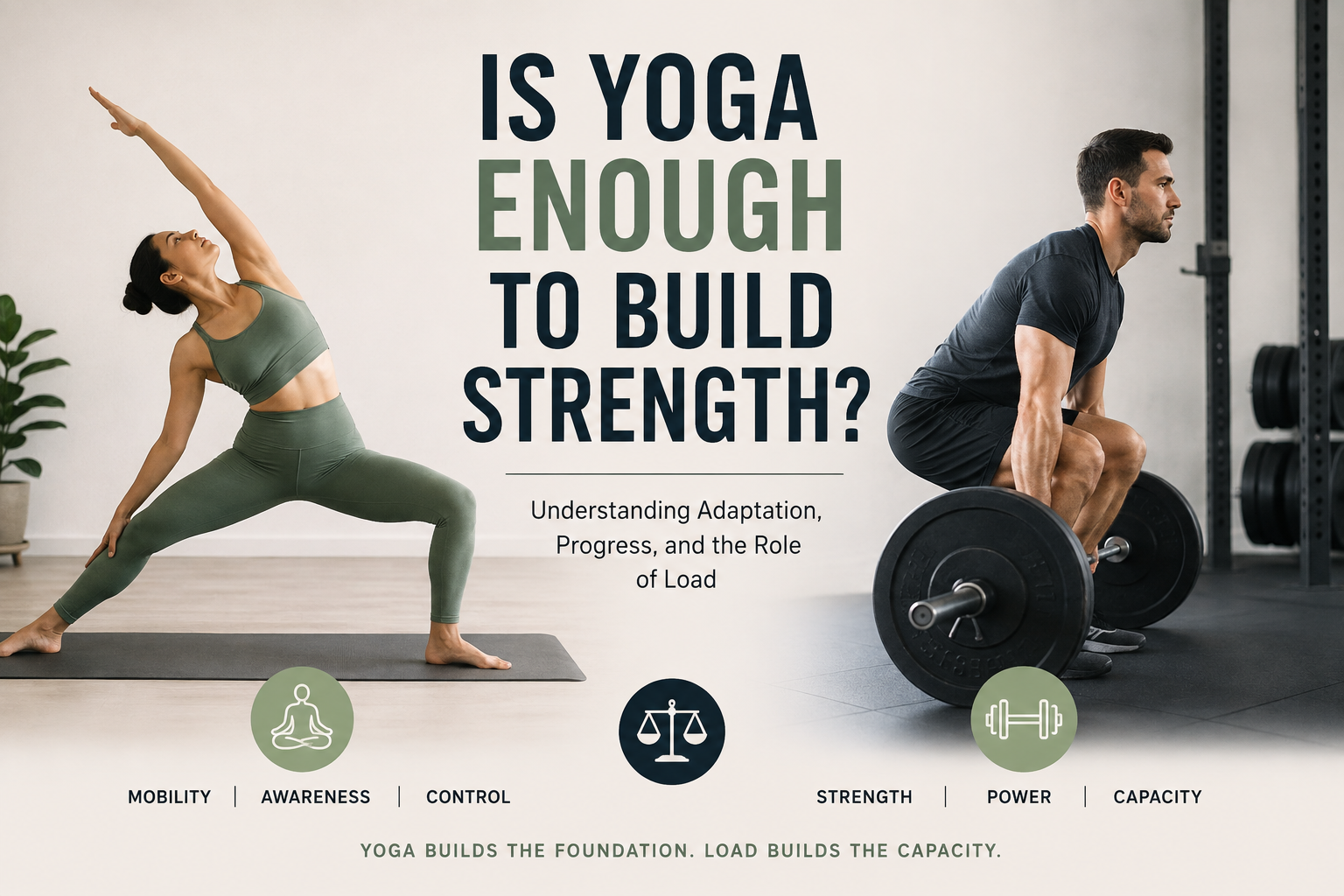
Is Yoga Enough to Build Strength? What the Science Says
Short answer: It depends on who is asking.
Longer answer: It depends on what you mean by strength and where you are in your fitness journey.
To answer that, we need to start with one important concept:
Your Body Only Changes When You Give It a Reason
Everything in training comes back to one principle: adaptation.
You ask your body to do something it isn’t quite ready for, and it adapts so it’s better prepared the next time. Push a little beyond what’s comfortable, recover, and return a little stronger, a little more capable.
Whether you’re flowing through a yoga class or standing under a barbell, that’s how progress happens.
So the real question isn’t whether yoga counts as exercise—it absolutely does.
The better question is: What kind of adaptation is yoga asking your body to make, and does that match your goals?
Your First Strength Gains Aren’t Mostly Muscle
Here’s something that surprises a lot of people.
When you begin any new type of training, the first several weeks of improvement come primarily from your nervous system, not from building new muscle tissue.
Your brain becomes better at sending the signal. More motor units fire, they fire more efficiently, and the muscles that should stay quiet learn to stay quiet. You simply become better at performing the movement.
That’s why a pose that felt impossible during your first class can feel comfortable six weeks later.
You probably haven’t built much new muscle during that time—you’ve simply become better at using what you already have.
That’s a real adaptation, and it deserves credit. It’s also why yoga can make people feel dramatically stronger in the beginning. For many people, that feeling is absolutely accurate.
Why Progress Eventually Plateaus
Muscle contraction happens on a spectrum.
Your body recruits muscle fibers in a predictable order. Smaller, more fatigue-resistant fibers are called upon first because they’re efficient and handle most everyday activities. The larger, more powerful fibers stay in reserve until the demand becomes high enough that your body has no other choice.
Those reserve fibers are where much of your true strength development occurs.
Now imagine you’ve been practicing yoga consistently for several months.
Your body weight hasn’t changed much, but your capacity has.
Twenty chaturangas that once left your arms shaking are now just part of the flow. Holding Chair Pose for a minute is uncomfortable, but manageable.
The load hasn’t increased—but you’ve adapted.
As a result, the challenge that once pushed your limits now falls comfortably below them.
At that point, you’re still improving, but the adaptation has shifted. Instead of building maximal strength, you’re developing muscular endurance, movement efficiency, and refined motor control.
Those are valuable qualities.
They’re just different from becoming significantly stronger.
What External Load Changes
Adding external resistance solves a simple problem:
It allows the demand to keep increasing as your body adapts.
Heavy squats, deadlifts, carries, presses, and other resistance exercises recruit those larger reserve muscle fibers that bodyweight movement alone eventually stops challenging.
Unlike bodyweight, external load can continue increasing for years, allowing your body to keep adapting.
This becomes even more important as we age.
Bone density responds to load.
Muscle mass—which naturally declines over time—responds to load.
Getting off the floor with ease, catching yourself when you trip, carrying groceries upstairs, or lifting a child are all expressions of strength that require more than simply holding a position.
Yoga contributes to these abilities, but progressive resistance training develops them more effectively.
This Isn’t an Argument Against Yoga
Far from it.
Yoga develops qualities that a barbell often doesn’t.
It reveals movement asymmetries you might otherwise compensate around. It builds body awareness, balance, coordination, and control in deep ranges of motion. It improves mobility while teaching you how to own that mobility.
Those qualities often make people better lifters, better runners, and better movers overall.
The best part?
No one is asking you to choose between yoga and strength training.
If strength is your goal, yoga provides an excellent foundation—and an even better complement.
At some point, though, if you want to continue getting stronger, the load has to come from outside your body.
So, Is Yoga Enough?
If you’re new to exercise or returning after time away, yoga may absolutely be enough to make you stronger—for a while.
Keep going.
You’re adapting, your body is responding, and there’s nothing to fix.
But if you’ve been practicing consistently and your strength has stopped improving, that isn’t a motivation problem or a discipline problem.
It simply means your body has adapted to the current challenge.
The stimulus no longer matches the goal.
The good news?
That’s a very solvable problem.
Building the Bridge
At Physio Room, we help people bridge the gap between mindful movement and progressive strength training.
We meet you where you are, evaluate what your body currently tolerates, and help you safely introduce the right amount of resistance to continue making progress.
You don’t have to give up yoga to get stronger.
You just have to give your body a new reason to adapt.

Written by Austyn Brown, Certified Personal Trainer | Physio Room
Connect with Physio Room:
Find Us On Our Socials
Website
Instagram
Facebook