


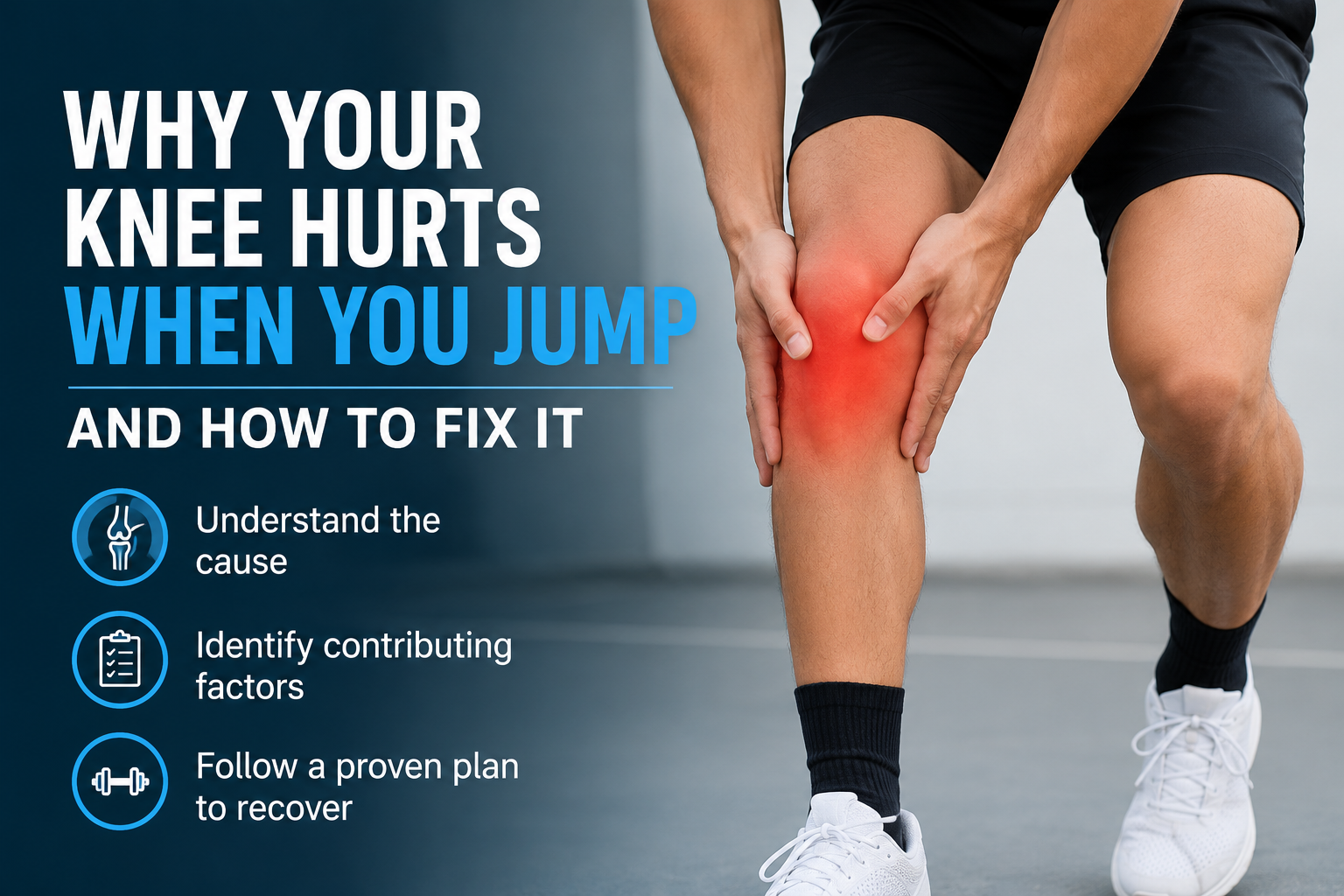
Why Your Knee Hurts When You Jump (And How to Fix It)
If you are an athlete experiencing pain in the front of your knee—especially when jumping, landing, squatting, or getting up after sitting—you may be dealing with patellar tendinopathy, commonly known as jumper’s knee.
This condition is common in sports that involve repetitive jumping and explosive movements like:
- Basketball
- Volleyball
- Track & field
- CrossFit
- Soccer
In this blog, we’ll break down what patellar tendinopathy is, why it happens, and how to start fixing it.
What Is Patellar Tendinopathy?
Patellar tendinopathy is a condition involving irritation and overload of the patellar tendon, which sits just below the kneecap.
Pain is usually localized:
- Directly below the kneecap
- Occasionally above the kneecap in the quad tendon
The biggest symptom?
Pain with activities that demand force from the quadriceps (quad muscles), especially:
- Jumping
- Landing
- Cutting
- Sprinting
- Single-leg movements
- Deep squatting
The tendon becomes overloaded when demands exceed the body’s ability to recover.
As training intensity, jumping volume, or sport demands increase, the tendon may not get enough time to adapt—leading to pain and irritation over time.
Why Does Jumper’s Knee Happen?
While the pain is felt in the knee, the problem is often bigger than just the knee itself.
At Physio Room, we evaluate the entire movement system, including:
- The hips
- The knees
- The ankles
- Foot mechanics
Research has shown several common factors associated with patellar tendinopathy, including:
Hip Weakness
Weakness in the hip abductors (side hip muscles) can reduce lower body stability and increase stress on the knee.
Quad Weakness
The quadriceps are responsible for absorbing force during jumping and landing. Weakness or poor load tolerance can overload the tendon.
Ankle Stiffness
Limited ankle mobility changes movement mechanics and can shift more stress into the knee joint.
Flat Feet or Foot Instability
Poor foot control can create instability through the ankle and lower leg, increasing force demands at the knee.
How to Start Fixing It
The first step is making sure the pain is truly patellar tendinopathy.
Not all front-of-knee pain is the same, which is why a proper evaluation matters. Other knee conditions may require a different treatment approach.
Once we identify the root causes, treatment focuses on:
- Reducing pain
- Improving tendon load tolerance
- Restoring strength and stability
- Gradually returning to sport-specific activity
Start With Isometric Exercises
One of the best early-stage tools for tendon pain is isometric loading.
Isometric exercises involve holding a position under tension without movement and are often very effective for reducing tendon pain.
Example: Isometric Knee Extension Hold
- Slightly extend the knee against resistance
- Hold for up to 45 seconds
- Stop if pain significantly increases
The goal is to work in a:
- Pain-free range
- Mild pain range only
If symptoms worsen significantly, the exercise is likely too aggressive.
Progress Into Strength Exercises
As pain becomes more manageable, we progress into:
- Eccentric exercises (controlled lowering)
- Concentric exercises (strengthening while lifting)
One of our favorite exercises is the Spanish Squat.
Spanish Squat Benefits
- Loads the quads safely
- Builds tendon tolerance
- Improves lower body strength
During these exercises, it’s important to monitor knee angle and symptoms.
Understanding Knee Flexion and Pain
Once the knee moves beyond roughly 60 degrees of flexion in weight-bearing positions, pressure inside the knee joint increases significantly.
If deeper bending aggravates symptoms:
- Reduce squat depth
- Return to more open-chain exercises
- Continue building tolerance gradually
Pushing aggressively through pain usually slows recovery.
The Biggest Takeaways
If you’re dealing with jumper’s knee, remember:
Avoid Constantly Aggravating Symptoms
You do not want to repeatedly overload the tendon with painful jumping or explosive activity.
Stay Active in a Tolerable Range
Movement is important—but exercises should stay within a mild-pain or pain-free range.
Address the Entire System
Hip strength, ankle mobility, foot stability, and quad capacity all matter.
Get the Right Diagnosis
Not all knee pain is jumper’s knee. A proper assessment helps determine the true cause and the best plan moving forward.
Get Back to Jumping Stronger
At Physio Room, our goal is not just to calm symptoms down.
We want to help athletes:
- Jump confidently
- Cut explosively
- Move efficiently
- Return stronger than before
If knee pain is limiting your training or sport, let’s figure out why and build a plan that gets you back to doing what you love.

Written by By Dr. Chris Hildenbrand, PT, DPT | Physio Room
Connect with Physio Room:
Find Us On Our Socials
Website
Instagram
Facebook