


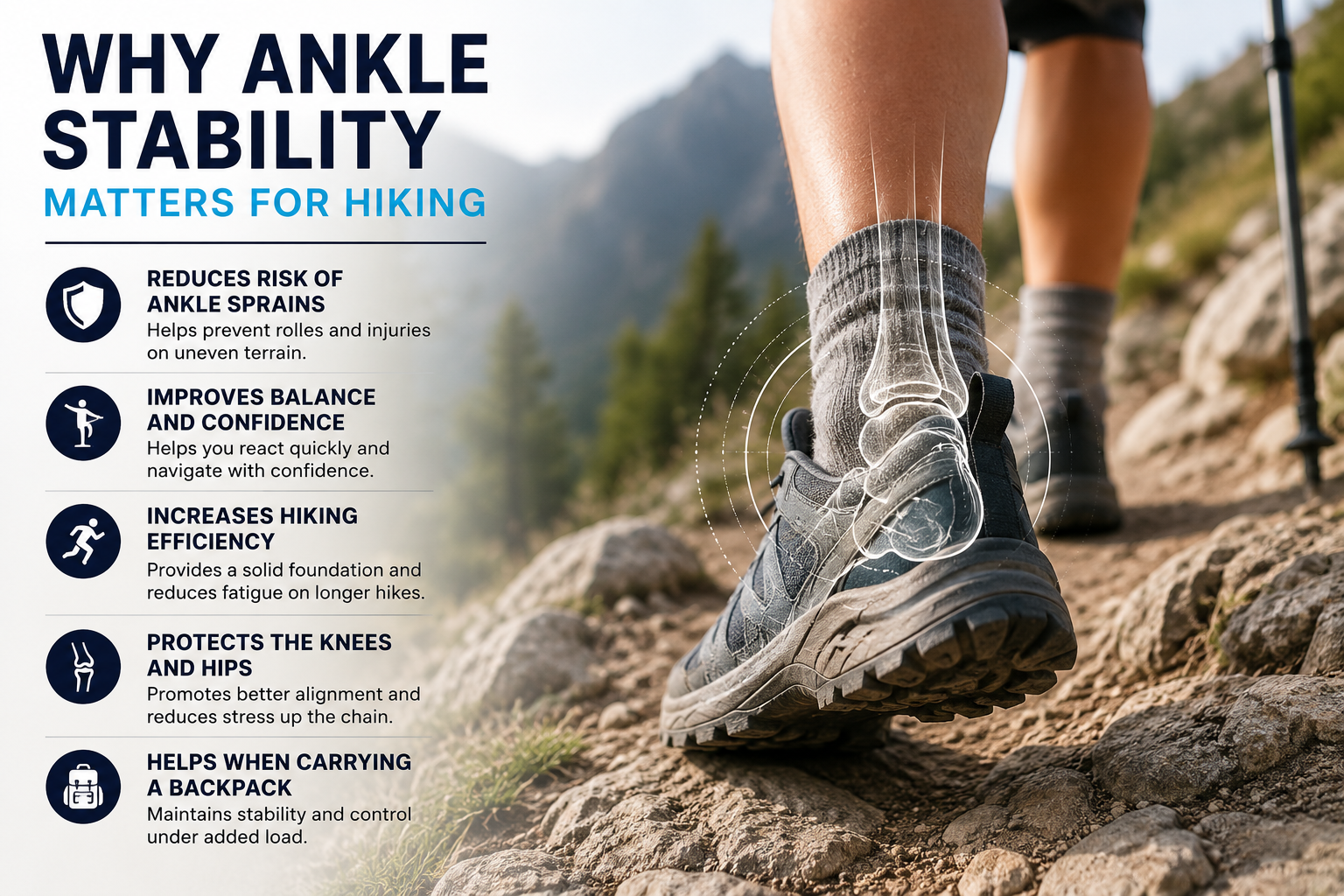
Why Ankle Stability Matters for Hiking
When most hikers think about preparing for the trail, they focus on cardiovascular fitness, leg strength, or the right gear. While those factors are important, one often-overlooked component can make a significant difference in both performance and injury prevention:
Ankle Stability
Whether you’re navigating rocky track, crossing streams, descending steep terrain, or carrying a loaded backpack, your ankles serve as the foundation for every step you take. Strong, stable ankles can help you hike more efficiently, reduce injury risk, and improve your confidence on challenging terrain.
Let’s take a closer look at why ankle stability is so important for hikers.
1. Reduces the Risk of Ankle Sprains
Hiking trails are rarely predictable.
Roots, rocks, loose gravel, uneven surfaces, and sudden changes in terrain constantly challenge your balance and foot placement. Without adequate ankle stability, a small misstep can quickly turn into a painful ankle sprain.
Strong ankles help control unexpected changes in foot position and improve your ability to react to uneven ground, reducing the likelihood of rolling an ankle on the trail.
2. Improves Balance and Confidence
Every hike requires continuous adjustments to maintain balance.
Whether you’re stepping across a creek, navigating a rocky section, or descending a steep trail, your ankles play a critical role in keeping you upright and stable.
Improved ankle stability allows you to:
- React more quickly to changing terrain
- Maintain better balance on uneven surfaces
- Move with greater confidence on technical trails
- Reduce hesitation during challenging sections
The more stable your ankles are, the more confident you’ll feel exploring new terrain.
3. Increases Hiking Efficiency
Your ankles are the first point of contact with the ground and serve as the foundation for the entire lower body.
When ankle stability is lacking, the body often compensates by relying on other muscles and joints to maintain balance. These compensations require additional energy and can increase fatigue over the course of a hike.
Stable ankles help create a strong foundation for the:
- Knees
- Hips
- Core
As a result, you move more efficiently and conserve energy during longer adventures.
4. Protects the Knees and Hips
The body functions as a connected system.
When the ankles struggle to provide stability and control, the joints above them often have to work harder. Over time, this can place additional stress on the knees, hips, and lower back.
Poor ankle control may contribute to:
- Excessive knee movement
- Altered walking mechanics
- Increased stress on the hips
- Reduced efficiency on uneven terrain
Developing ankle stability helps improve alignment throughout the lower body and promotes more controlled movement with every step.
5. Helps When Carrying a Backpack
Adding a backpack changes more than just the weight you’re carrying.
The additional load shifts your center of gravity and increases the demands placed on your ankles with every step. This is especially noticeable during steep climbs, technical descents, or multi-day hiking trips.
Strong, responsive ankles help you:
- Maintain balance under load
- Adapt to changing terrain
- Improve control on descents
- Reduce the risk of slips and falls
The heavier your pack, the more important ankle stability becomes.
The Bottom Line
Strong ankle stability is one of the most valuable—and often overlooked—components of hiking performance.
Stable ankles can help you:
- Reduce your risk of ankle sprains
- Improve balance and confidence
- Hike more efficiently
- Protect your knees and hips
- Stay stable while carrying a backpack
Whether you’re preparing for a weekend hike or a multi-day backcountry adventure, investing time in ankle strength, balance, and stability training can help keep you moving confidently on the trail.
After all, every great hike starts from the ground up.

Written by By Dr. Karissa Deptula, PT, DPT, Cert. DN | Physio Room
Connect with Physio Room:
Find Us On Our Socials
Website
Instagram
Facebook