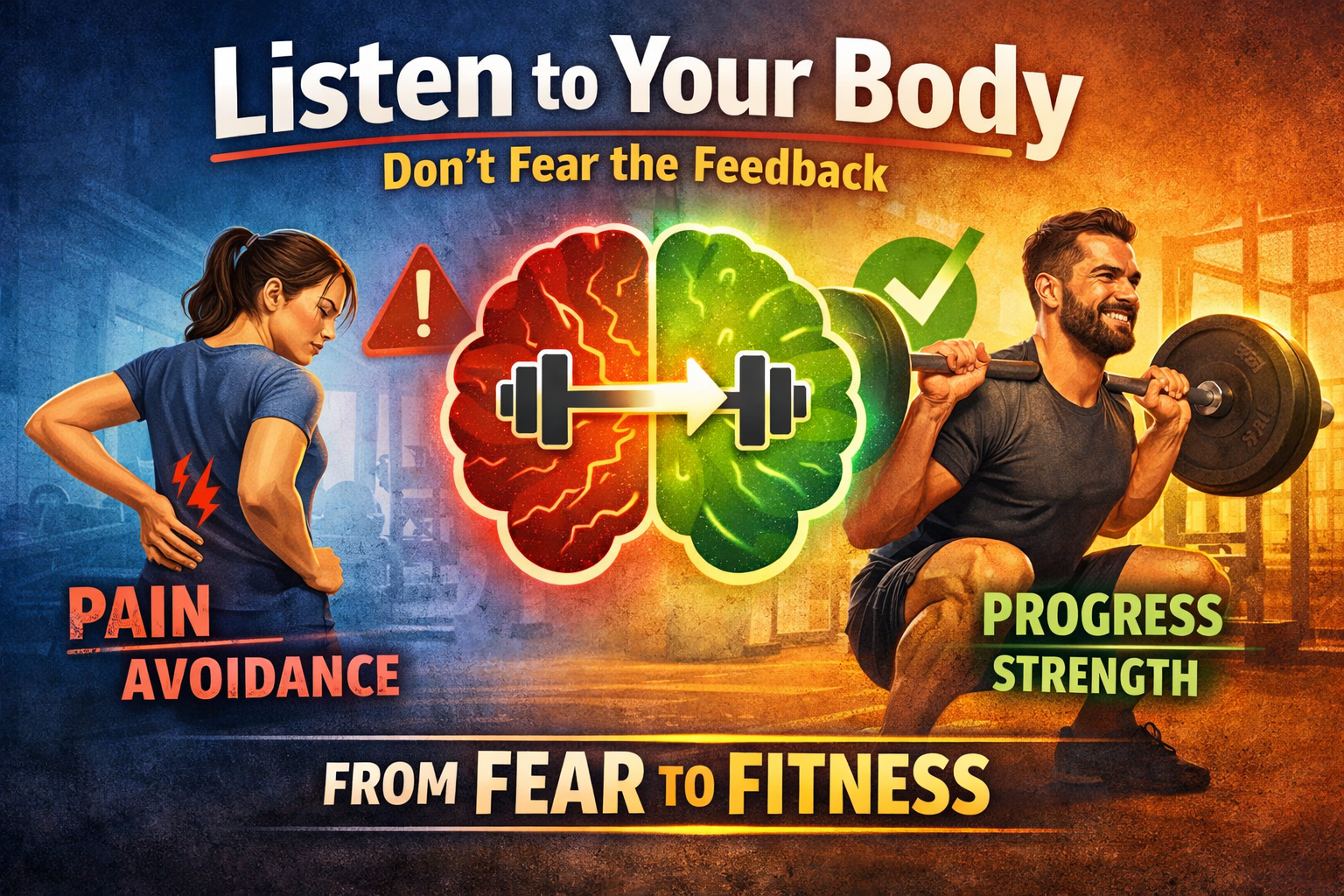
Listen to Your Body — Don’t Fear the Feedback
Most people grow up hearing:
“If it hurts, stop.”
Sometimes that’s appropriate.
But often, discomfort in movement isn’t a stop sign — it’s feedback.
The difference between getting stuck and getting stronger usually comes down to how that feedback is interpreted. That’s where a fitness-forward physical therapy team makes a huge difference.
Discomfort vs. Danger
Not all pain means the same thing.
There’s a clear difference between:
🚨 Signals That Need Protection
- Sharp, escalating pain
- Instability or “giving way”
- Swelling
- Sudden loss of strength
✅ Signals That Often Need Exposure
- Mild soreness
- Stretch discomfort
- Fatigue in a deconditioned area
- A familiar ache that settles quickly
The first category needs assessment and protection.
The second often needs progressive exposure.
A fitness-forward physical therapy team helps you understand which is which — so you’re not overreacting to normal adaptation or ignoring something that truly needs attention.
Bridging Rehab and Training
Traditional rehab often stops at pain reduction.
Fitness-forward rehab focuses on restoring capacity.
At Physio Room, that means:
- Rebuilding strength — not just range of motion
- Progressing load strategically — not avoiding it
- Using gym-based movements to retrain confidence
- Speaking the language of training — not just treatment
Instead of saying, “Don’t squat,” we ask:
- How can we squat safely?
- What variation works right now?
- What dose builds tolerance?
That mindset keeps people moving forward.
Example: Low Back Pain
Someone with recurring back pain often avoids bending or lifting.
That avoidance leads to:
- Reduced strength
- Increased sensitivity
- More fear
A fitness-forward approach might include:
- Reintroducing hip hinges with tempo control
- Using partial range deadlifts
- Gradually increasing load week to week
- Tracking symptom response after sessions
The message becomes:
“Your back isn’t fragile. It needs graded exposure.”
That shift alone can change outcomes.
Example: Shoulder Irritation
After shoulder pain, overhead work can feel threatening.
Rather than eliminating pressing completely, we might:
- Use landmine presses
- Adjust grip width
- Build scapular strength
- Gradually return to strict overhead work
The shoulder doesn’t improve through avoidance — it improves when load is reintroduced intelligently.
Reducing Fear, Increasing Control
Pain isn’t just physical — it’s influenced by the nervous system.
If every uncomfortable sensation leads to stopping, the brain learns:
“This movement is unsafe.”
A fitness-forward physical therapy team helps you safely challenge that belief through:
- Movement assessment under load
- Clear symptom guidelines
- Education around pain science
- Structured progression
We replace fear with informed confidence.
Why This Matters
The biggest long-term limiter usually isn’t tissue damage — it’s fear and underloading.
When people believe:
- “My knee can’t handle running”
- “My back is weak”
- “My shoulder is permanently damaged”
They shrink their world.
But when they understand:
- What’s safe
- What’s adaptable
- What can be progressed
They expand it.
The Bottom Line
Discomfort isn’t something to blindly push through —
and it’s not something to automatically avoid.
It’s information.
A fitness-forward physical therapy team helps you interpret that information, apply it strategically, and build real-world capacity — so you don’t just feel better…
You move better.
You perform better.
That’s how rehab turns into resilience.

Written by By Jack Butler, PTA, Strength Coach| Physio Room
Connect with Physio Room:
Find Us On Our Socials
Website
Instagram
Facebook