


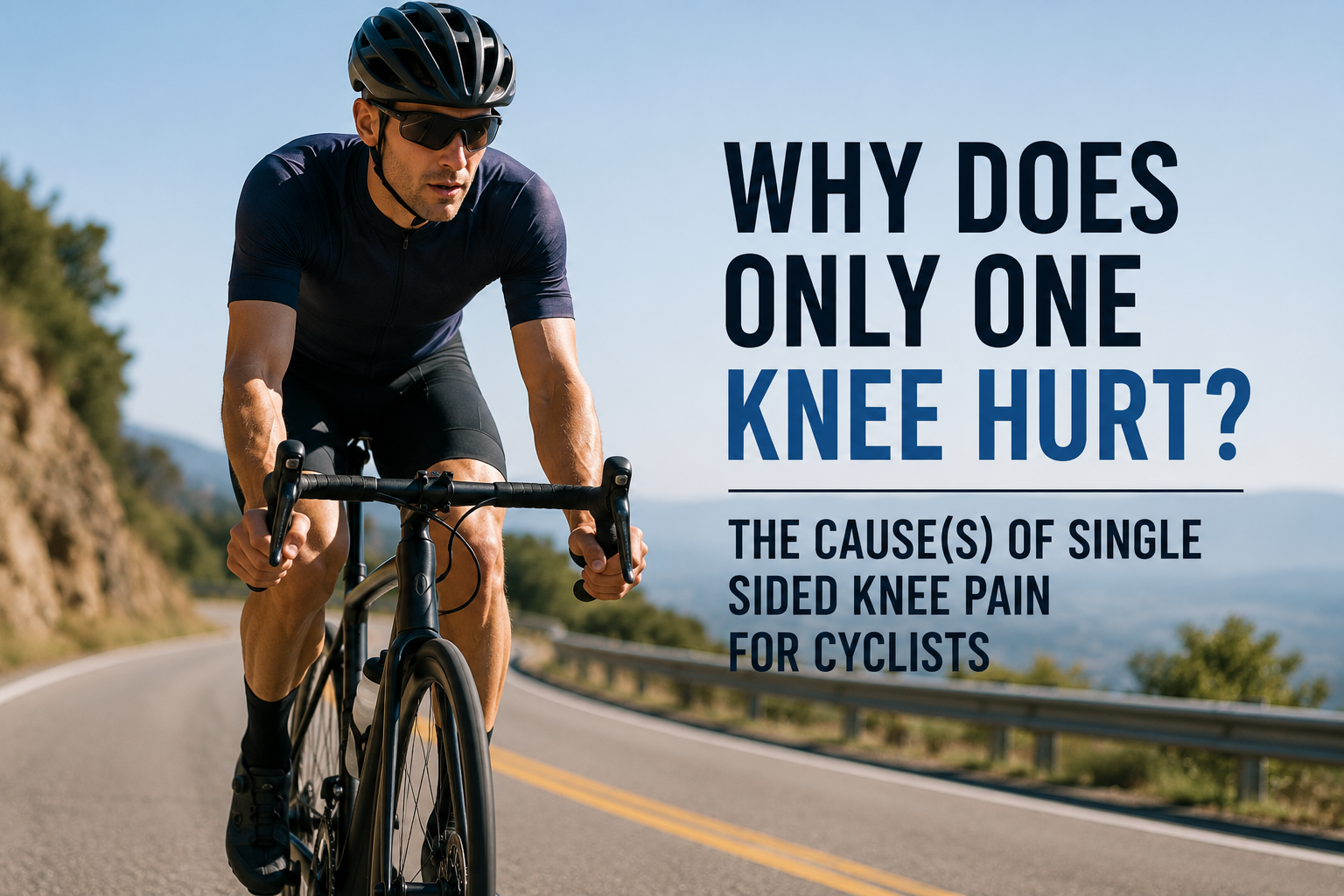
Why Does Only One Knee Hurt While Cycling? The Hidden Causes of Single-Sided Knee Pain
For experienced cyclists, single-sided knee pain is actually the norm—not the exception.
When only one knee hurts, it often points to an asymmetry somewhere in the system. This could be a dominant leg, a subtle pelvic imbalance, differences in foot mechanics, or even a small leg length discrepancy.
If both knees hurt equally, the issue is more likely to be a global bike fit problem, such as saddle height or position. But when only one knee is painful, something is usually different between the left and right sides of the body.
Let’s look at some of the most common causes of single-sided knee pain in cyclists and why these asymmetries matter.
1. Leg Dominance and Compensation Patterns
One of the most overlooked causes of single-sided knee pain is leg dominance.
Most cyclists naturally favor one leg over the other without realizing it. Over thousands of pedal strokes, the body develops compensation strategies that often increase asymmetry rather than reduce it.
For many riders, the right leg tends to be stronger, more coordinated, and capable of producing more power. As a result, the body may rely on the dominant side while the opposite leg absorbs more stress and operates with less efficient mechanics.
This is one reason why left-sided knee pain is often more common in cyclists. The non-dominant side may struggle with force production, control, and stability, placing additional strain on the knee over time.
2. Leg Length Discrepancies
Even a small difference in leg length can have a significant impact on cycling mechanics.
A discrepancy of just a few millimeters may go completely unnoticed during daily activities, but cycling involves thousands of repetitive movements in a fixed position. Small asymmetries become magnified over long rides.
When one leg is longer than the other, the pelvis may sit unevenly on the saddle, causing one knee to travel through a slightly different path with every pedal stroke.
Single-sided knee pain is often the result of these repetitive asymmetrical loading patterns, especially when combined with other muscular or mobility imbalances.
3. Foot and Ankle Mechanics
Sometimes knee pain isn’t really a knee problem at all.
The foot and ankle serve as the foundation of the lower extremity. If one foot pronates more than the other or has reduced stability under load, the knee may be forced into a less efficient movement pattern.
Common foot and ankle issues that can contribute to one-sided knee pain include:
- Excessive pronation
- Collapsing arches
- Limited ankle mobility
- Differences in foot stability between sides
Because most people have some degree of asymmetry in foot mechanics, it’s common for only one knee to experience increased stress during cycling.
4. Pelvic Obliquity
Pelvic obliquity refers to a subtle tilt or asymmetry of the pelvis.
This can occur because of structural differences, muscle imbalances, or bike fit variables such as saddle position and Q-factor.
One of the challenges with pelvic obliquity is that it can be difficult to identify without a detailed assessment. The pelvis may appear level while riding, but small compensations can alter hip motion and knee tracking throughout the pedal stroke.
Over time, these changes may lead to excessive loading on one side and contribute to persistent knee pain.
5. Hip Muscle Imbalances
The hip plays a critical role in controlling lower extremity alignment during cycling.
When one side is weaker or less stable than the other, the femur may rotate excessively during the pedal stroke. This changes the position of the knee and can increase stress on surrounding tissues.
A common example is weakness of the gluteus medius, which helps stabilize the pelvis and control leg alignment.
When the hip loses its ability to provide stability, the knee often becomes the joint that absorbs the resulting movement and stress.
The side with poorer hip control is frequently the side that develops symptoms.
The Bottom Line
Single-sided knee pain is usually a sign that something is different between the left and right sides of the body.
Whether the source is leg dominance, a leg length discrepancy, foot mechanics, pelvic positioning, or hip strength, the underlying issue is often asymmetry and the compensation strategies that follow.
The goal isn’t simply to treat the painful knee. The goal is to identify why that knee is being asked to do more work than the other.
This is where working with a physical therapist who also understands bike fitting can be especially valuable. By evaluating both the rider and the bike simultaneously, it’s possible to identify the source of the asymmetry, improve positional stability, and create a more efficient and comfortable ride.

Written by By Dr. Tim Tracy, PT, DPT, OCS | Physio Room
Connect with Physio Room:
Find Us On Our Socials
Website
Instagram
Facebook