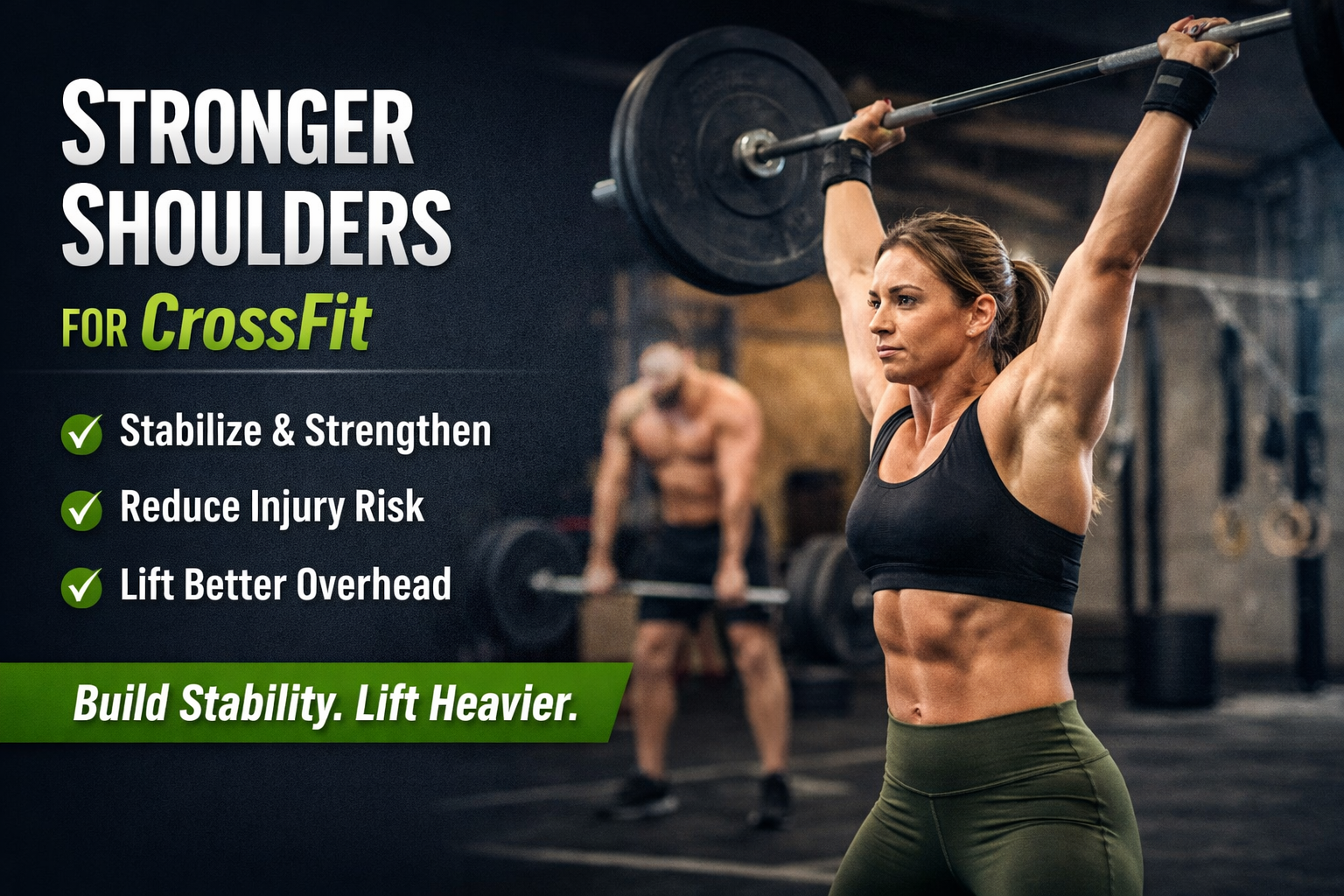
Stronger Shoulders for CrossFit: Build Stability for Better Lifts
The shoulder is a ball-and-socket joint, designed for movement in multiple directions. This gives it incredible mobility — the ability to move freely through a full range of motion.
But that mobility comes with a trade-off.
While it allows for high-level athletic performance, it also makes the shoulder one of the most vulnerable joints in the body.
Why CrossFit Athletes Need to Prioritize Shoulder Health
CrossFit places high demands on the shoulders through movements like:
- Olympic lifts
- Overhead pressing
- Gymnastics
- Kipping movements
These are fast, powerful, and often repetitive — requiring more than just strength.
They demand:
- Joint control
- Stability
- Coordination
Without proper preparation, the shoulders become more susceptible to:
- Pain
- Irritation
- Decreased performance
- Long-term injury
To lift heavier, move better, and stay healthy, athletes must prioritize stability before intensity.
Build Stability Before the WOD
One of the simplest ways to protect your shoulders and improve performance is by adding a short activation routine before training.
This helps:
- Engage stabilizing muscles
- Improve coordination
- Prepare the joint for high-intensity work
Use this sequence as part of your warm-up before any upper-body or overhead session.
Shoulder Activation Routine
1. Row + Shoulder External Rotation at 90°
10–12 reps
- Strengthens the upper back and rotator cuff
- Improves shoulder control and posture
2. Bottoms-Up Kettlebell Shoulder Press
10 slow, controlled reps
- Builds shoulder stability and grip strength
- Reinforces proper joint alignment
3. Scapular Push-Ups
10 reps
- Activates the serratus anterior
- Improves shoulder blade control for pressing and pull-ups
4. Banded “T” Raises
10 reps (with a pause)
- Strengthens the rear delts and upper back
- Promotes healthy shoulder positioning
The Bottom Line
Strong shoulders aren’t just built through heavy lifts — they’re built through control, stability, and consistency.
If you want to:
- Lift more weight
- Move more efficiently
- Stay pain-free
Start by preparing your shoulders before the workout — not reacting after something starts to hurt.
Because better prep leads to better performance.

Written by By Dr. Karissa Deptula, PT, DPT, Cert. DN| Physio Room
Connect with Physio Room:
Find Us On Our Socials
Website
Instagram
Facebook