

How to Transition to Trail Running (Without Getting Injured)
With spring around the corner and longer days ahead, many runners are ready to trade the treadmill for the trails.
But one question comes up every year:
“How do I safely transition from road running to trail running?”
At Physio Room, we hear it all the time — and for good reason.
Trail running is an incredible way to build strength, improve endurance, and enjoy the outdoors… but it also places very different demands on your body compared to road running.
Before you hit the trails, here’s what you need to understand — and how to prepare your body the right way.
The Biggest Differences Between Road and Trail Running
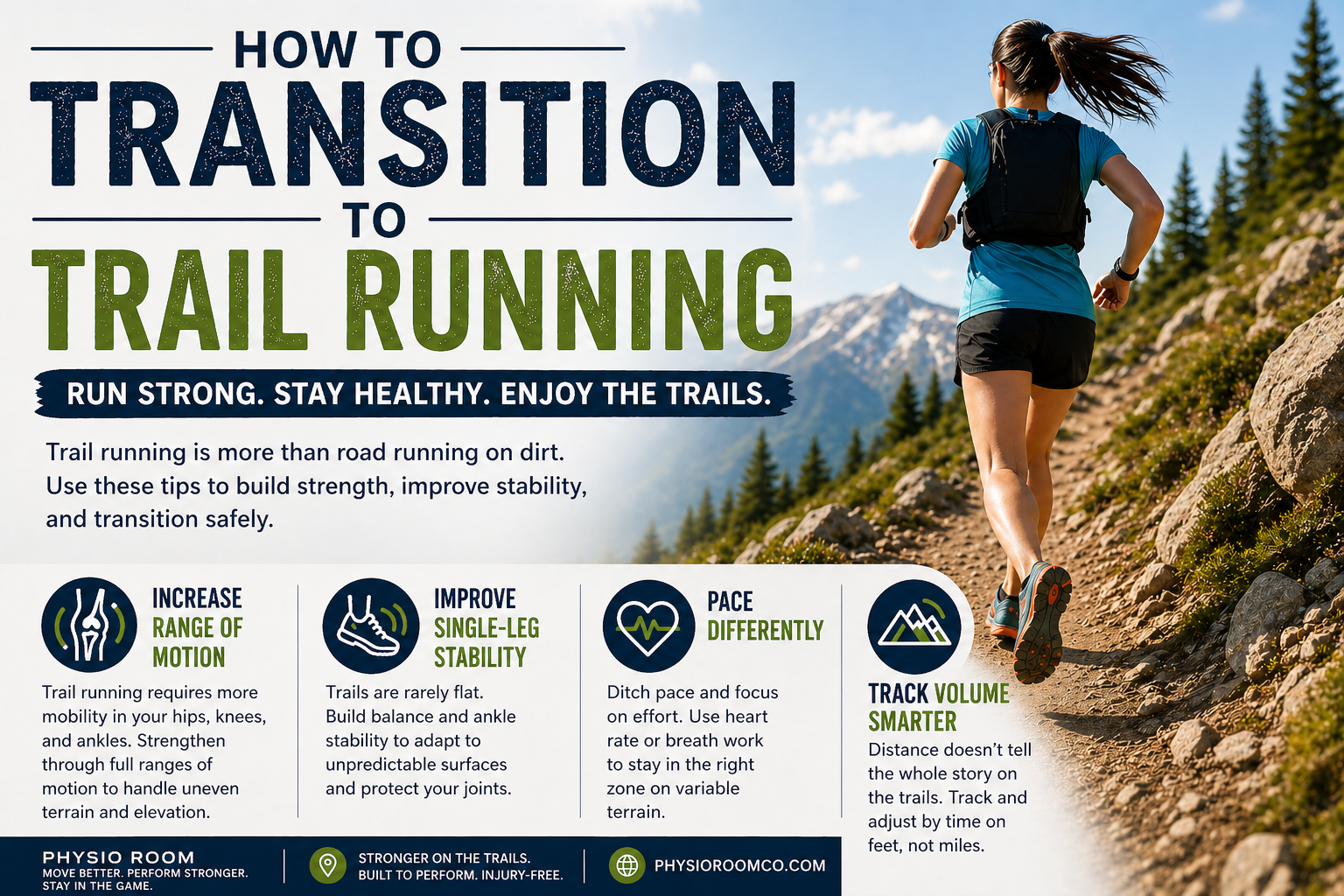
1. Increased Range of Motion
Trail running requires more movement at your:
- Hips
- Knees
- Ankles
Uneven terrain, elevation changes, and variable foot placement force your body to adapt constantly.
If you don’t have the mobility to handle it, your body will compensate — and that’s where injuries start.
What to do:
Focus on strengthening through full ranges of motion, not just partial movements.
👉 A great place to start: Bulgarian Split Squats
- Builds strength through deeper hip and knee angles
- Improves control in positions you’ll actually use on trails
2. Single-Leg Stability Matters More
On the road, your foot usually lands on a predictable, flat surface.
On the trail? Almost never.
Every step is slightly different — which means your ankle, knee, and hip must constantly stabilize.
If your ankle can’t adapt, the stress often shifts upward to the knee or hip.
What to do:
Train single-leg balance and control, especially at the ankle.
👉 Try: Star Balance Drill
- Improves ankle stability
- Builds control in multiple directions
- Mimics real trail demands
3. You Have to Rethink Pacing
On the road, pacing is straightforward.
On the trail, it’s not.
Elevation, terrain, and footing make pace a poor measure of effort.
If you try to hold your normal pace, you’ll likely:
- Overwork on climbs
- Fatigue too quickly
- Increase injury risk
What to do:
Shift your focus from pace → effort.
Better ways to gauge effort:
- Heart rate zones
- Breath control
👉 Simple rule:
If you can’t maintain nasal breathing during an easy run, slow down or power hike until you can.
4. Track Volume Differently
Most runners track mileage to manage training load.
But on trails, distance doesn’t tell the full story.
Five trail miles with elevation can be significantly more demanding than five flat road miles.
What to do:
Track volume by time on feet, not just distance.
This helps you:
- Avoid sudden spikes in load
- Progress more gradually
- Reduce injury risk
The Bottom Line
Trail running isn’t just road running on dirt — it’s a different stimulus entirely.
If you want to:
- Stay injury-free
- Build real strength
- Enjoy the transition
You need to prepare your body for:
- Greater range of motion
- Increased stability demands
- Variable pacing
- Smarter volume management
Ready to Hit the Trails?
With the right preparation, trail running can be one of the most rewarding ways to train.
Take the time to build the foundation now — and your body will thank you later.
We’ll see you out on the trails.

Written by By Dr. Drew Short, PT, DPT, CMFA| Physio Room
Connect with Physio Room:
Find Us On Our Socials
Website
Instagram
Facebook