The Aging Flex Curve: Why Your Once-Perfect Bike Fit May Now Cause Pain
A Denver-area bike fitter’s guide to changing hamstring and spinal mobility and what to do when your old bike fit no longer works.
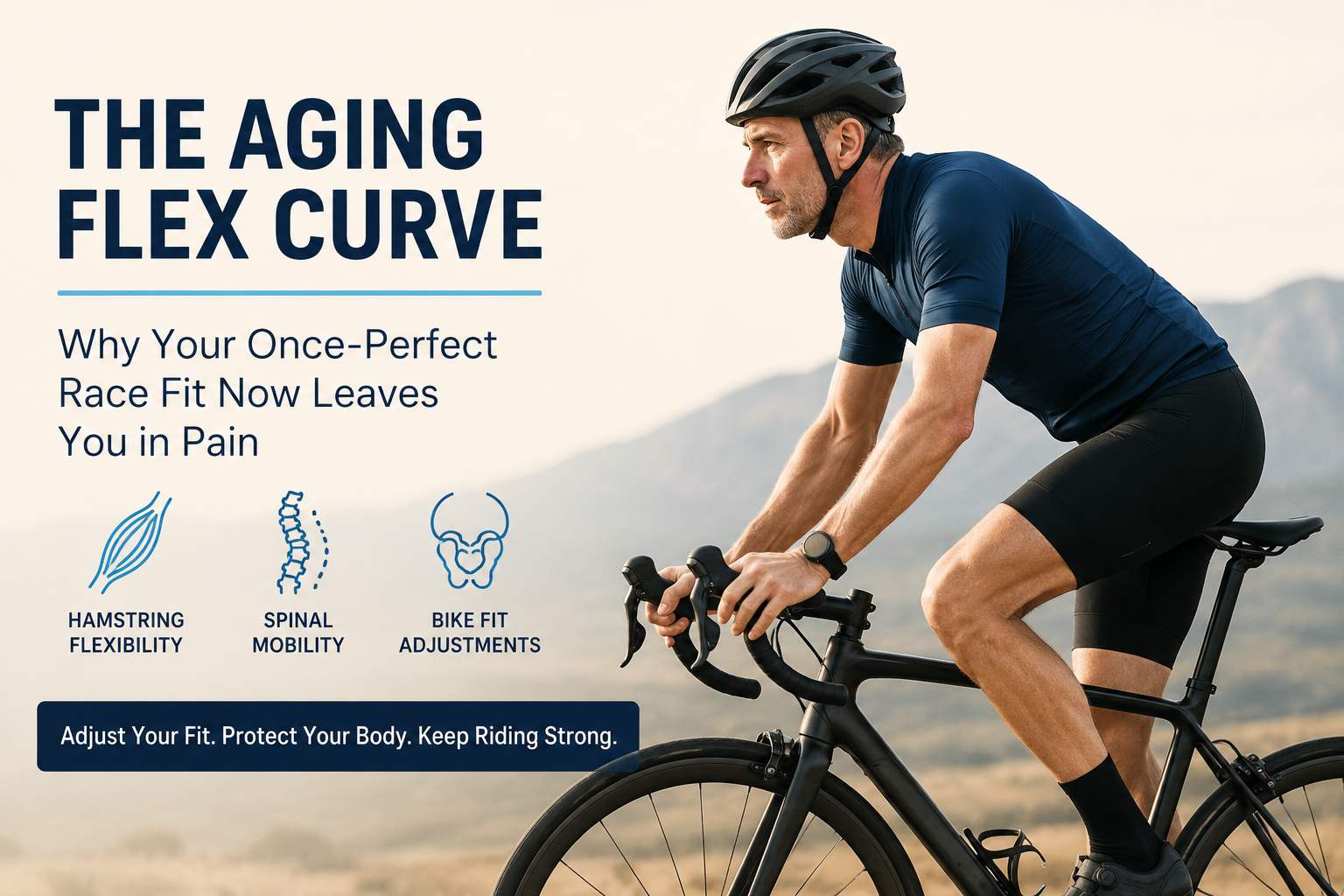
That aggressive race position that felt perfect in your 30s might not feel quite as comfortable in your 40s, 50s, and beyond.
If you’re suddenly experiencing lower back pain, hamstring discomfort, or hip tightness on the bike, your bike may not be the problem. Your body may have changed.
Over time, changes in flexibility, tissue tolerance, and spinal mobility can make it harder to comfortably maintain the same riding position you’ve used for years.
We call this the Aging Flex Curve.
The good news? You don’t necessarily have to accept the discomfort—or stop riding the way you love. Understanding how your body has changed can help you adjust your bike fit and training so you can continue riding comfortably and performing at a high level.
The Key Takeaways
- A bike position that once felt comfortable may begin causing back, hip, or hamstring discomfort as your mobility changes.
- Hamstring flexibility, spinal mobility, and connective tissue adaptability can change over time.
- An aggressive cycling position may eventually require more mobility than your body currently has available.
- A physical therapy–informed bike fit can assess both your body and your bike to determine where adjustments may help.
- Small changes to your position, combined with targeted mobility and strength work, can help you continue riding comfortably for years to come.
Why Your Bike Fit May Need to Change as You Age
We see this frequently among cyclists throughout the Denver metro area and at our Highlands Ranch clinic: riders who have trained and raced for years with a dialed-in bike fit, only to find that the same position gradually becomes uncomfortable.
The bike didn’t necessarily change.
The cyclist did.
Aging can bring gradual changes in tissue flexibility, mobility, recovery, and tolerance to sustained positions. Those changes may eventually turn a once-comfortable race position into one that requires your body to compensate.
Here are three areas that can play a role.
1. Hamstring Flexibility Can Decrease
Flexibility can gradually decline without consistent mobility and strength work.
For cyclists, changes in hamstring and posterior-chain mobility can be particularly important because an aggressive riding position requires adequate mobility through the hips and surrounding tissues.
When that mobility becomes limited, your body still has to find a way to reach the handlebars.
Instead of comfortably rotating through the pelvis and hips, you may begin compensating elsewhere—often through the lower back.
Over hundreds or thousands of pedal strokes, that compensation can contribute to discomfort.
2. Your Spine May Not Move the Way It Used To
Spinal mobility can also change over time.
Normal age-related changes to the discs, joints, and surrounding tissues can affect how comfortably your spine moves and tolerates prolonged positions.
That doesn’t mean cycling needs to become painful as you age.
It does mean that a highly aggressive position established 10 or 20 years ago may no longer match the mobility you have today.
When your body can’t comfortably achieve the position your bike requires, certain areas may take on more stress. For some cyclists, that can show up as persistent lower back pain during longer rides.
3. Connective Tissue Adaptability Can Change
It’s not just about muscles and joints.
The connective tissues surrounding the hamstrings, glutes, hips, and lower back also influence how your body transfers force and moves while cycling.
Changes in tissue mobility can affect the entire posterior chain. When one area becomes less adaptable, another area may compensate.
That’s one reason the location of your pain doesn’t always tell us the full story.
Why Does Cycling Pain Sometimes Feel Like It Started Suddenly?
Most cyclists don’t wake up one morning and suddenly lose their mobility.
The changes tend to happen gradually.
Pain, however, can feel much more sudden.
You might feel fine for months until something pushes your body past its current capacity, such as:
- A high-volume training block
- A particularly long ride
- Increased climbing
- A new race schedule
- More time spent in an aggressive position
- Changes in strength or mobility
- A period of reduced training followed by a rapid increase
The discomfort may seem new, but the underlying changes could have been developing for much longer.
Why “Just Get More Flexible” Isn’t the Whole Answer
Should you work on mobility? Absolutely.
Targeted mobility and strength training can help improve the way your body handles your riding position. But simply stretching your hamstrings isn’t always enough.
Mobility improvements require consistency, and your individual anatomy, training history, strength, and riding demands all matter.
More importantly, your bike fit should evolve alongside your body.
Rather than forcing yourself into a position chosen years ago, the goal should be finding the best position for the cyclist you are today.
What Makes a Physical Therapy–Based Bike Fit Different?
A traditional bike fit often focuses heavily on optimizing the relationship between the cyclist and the bike.
A physical therapy–based bike fit adds another layer by asking not only where your bike should be positioned, but also:
What position can your body comfortably, efficiently, and sustainably maintain?
At Physio Room, the bike fitting process can assess:
Posterior Chain & Pelvic Mobility
How much mobility do you currently have through your hips, hamstrings, and pelvis?
Spinal Mobility
How well can your spine move through the ranges necessary for your preferred cycling position?
Dynamic Movement on the Bike
What actually happens to your hips, pelvis, knees, and spine once you begin pedaling under load?
Your Performance Goals
Are you trying to maximize aerodynamics for racing, prepare for a century, or simply ride comfortably for several hours?
Your Current Physical Capacity
Does your body currently have the mobility, strength, and tolerance required to maintain your desired position?
From there, adjustments may be made to areas such as saddle position, handlebar height, reach, stack, and setback.
Sometimes a relatively small adjustment can significantly improve comfort.
Other times, the best approach combines bike-fit changes with targeted strength or mobility work.
The goal isn’t necessarily to make your position less performance-oriented. It’s to find the best balance between performance, efficiency, and what your body can sustainably tolerate.
Signs Your Old Bike Fit May No Longer Fit You
Consider having your bike fit and mobility assessed if you notice:
- Lower back pain that increases the longer you ride
- New or persistent hamstring tightness
- Hip or posterior thigh discomfort
- A riding position that suddenly feels like a constant stretch
- Difficulty staying in an aerodynamic position
- Needing to sit upright more frequently to relieve tension
- Pain that improves when you’re off the bike but consistently returns when you ride
- A previously comfortable bike position becoming progressively harder to maintain
These symptoms don’t automatically mean your bike fit is the cause. But they’re good reasons to look at your body and your bike together rather than treating them as separate problems.
You Don’t Have to Choose Between Performance and Comfort
Getting older doesn’t mean giving up performance.
It may simply mean your training and bike fit need to evolve with you.
A position that worked perfectly at 30 doesn’t necessarily need to remain unchanged at 45 or 55. Small adjustments can allow you to continue riding efficiently while respecting the mobility and capacity you have today.
When appropriate, targeted mobility and strength work may also help you regain some of the capacity needed for a more aggressive position.
Denver-Area & Colorado Springs Professional Bike Fitting
At Physio Room, we combine physical therapy assessment with professional bike fitting to look beyond the bike itself.
For cyclists throughout Denver, Highlands Ranch, the South Metro area, Colorado Springs, and the Front Range, this means you don’t have to choose between addressing pain and improving performance.
Whether you’re training for a Colorado gran fondo, preparing for a Front Range century, racing competitively, or simply hoping to keep riding comfortably into your 40s, 50s, and beyond, we can assess how your mobility, strength, and bike position are working together.
Because the goal isn’t simply to make your bike fit.
It’s to make sure your bike still fits you.
Ready to find out if your fit still fits? Contact our Highlands Ranch or Colorado Springs clinic to schedule a professional bike fit and movement assessment.

Written by Dr. Tim Tracy, PT, DPT, OCS, Cert. DN | Physio Room
Connect with Physio Room:
Find Us On Our Socials
Website
Instagram
Facebook