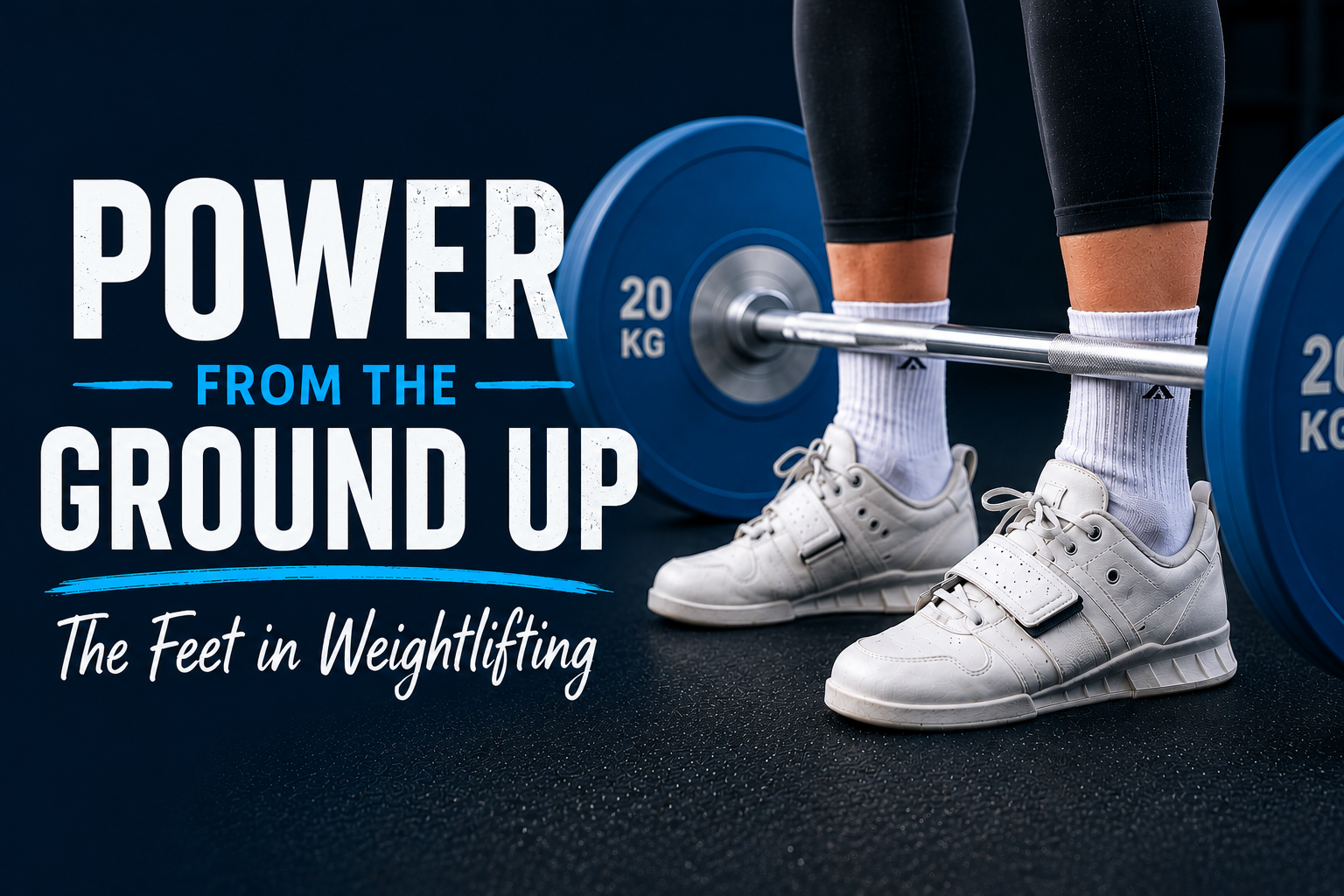
Power From the Ground Up: The Feet in Weightlifting
When we analyze movement in Olympic weightlifting, the conversation usually revolves around bar path, speed under the bar, hip and shoulder mobility, or pulling mechanics.
But one of the most important pieces of the lift often gets overlooked:
Your Feet
What exactly are they supposed to do?
Your feet are the foundation for every position in the snatch, clean, and jerk. They influence how you produce force, absorb load, stabilize under the bar, and transfer power from the ground upward.
If the foot and ankle aren’t doing their job efficiently, you’ll often see it show up elsewhere in the lift—sometimes subtly, sometimes dramatically.
Understanding foot mechanics can improve performance, positioning, efficiency, and even reduce unnecessary stress throughout the kinetic chain. And if you’re missing lifts without knowing exactly why, this may be the piece you’re overlooking.
The Foot’s Role in Weightlifting
The foot and ankle constantly shift between two critical functions:
Mobility & Adaptability
and
Stability & Force Production
A successful lift requires the foot to transition between these roles at the right time.
During setup, lifters are often coached to keep the entire foot connected to the floor with pressure distributed through the midfoot—not excessively on the heels or toes. This creates a stable platform to push force into the ground.
As the lift progresses through triple extension and into the receiving position, however, the demands on the foot change significantly.
Let’s break down these two movement strategies and why both are important.
Mobility & Adaptability: Understanding Pronation
Pronation occurs when the midfoot rolls slightly inward, the arch lowers, and the heel subtly everts outward.
In many fitness circles, pronation gets labeled as “bad.” In reality, controlled pronation is both normal and necessary.
The problem isn’t pronation itself—it’s excessive or uncontrolled pronation that can create issues.
Controlled Pronation Helps the Foot:
- Adapt to the ground
- Absorb load during squats
- Achieve better squat depth
- Distribute force through the midfoot
During the descent of a squat or receiving position, the foot needs some adaptability to allow adequate ankle dorsiflexion and efficient force absorption.
A completely rigid foot often struggles to absorb force and can make reaching proper squat depth more difficult.
Pronation isn’t inherently problematic. The challenge arises when an athlete cannot transition out of pronation effectively or when the movement becomes excessive.
In some cases, a stiff or overly rigid foot may actually contribute to discomfort by pushing stress upward into the knees or hips.
If one side struggles more than the other, you may also notice weight shifts, asymmetrical squatting patterns, or reduced control as the body compensates.
Stability & Force Production: Understanding Supination
Supination is essentially the opposite strategy.
During supination, the arch becomes more rigid, the foot stiffens, and the foot functions as a powerful lever for force production.
Just like pronation, supination is often misunderstood. A high arch or rigid foot isn’t automatically “good,” just as pronation isn’t automatically “bad.”
The goal isn’t living in one position—it’s having access to both.
Controlled Supination Helps the Foot:
- Create a stable platform
- Transfer force efficiently
- Improve power production
- Support heavy loads
This becomes especially important when:
- Standing from the squat
- Driving in the jerk
- Producing force during the pull
A stable foot allows force generated by the legs and hips to transfer efficiently into the barbell.
Too Much Supination Can Create Problems
An excessively rigid foot may contribute to:
- Limited squat depth
- Poor load distribution
- Reduced adaptability in the receiving position
- Excessive stiffness throughout the lower body
Like most aspects of movement, the goal isn’t choosing one strategy over the other. It’s developing the ability to transition between them when the lift demands it.
Force Transfer During Triple Extension
As a lifter moves into triple extension—simultaneous extension of the hips, knees, and ankles—the foot transitions toward plantarflexion as force is directed vertically into the ground.
At this stage, efficient force transfer becomes critical.
The foot should remain balanced and connected to the floor without excessive movement into either pronation or supination.
Most lifters will naturally demonstrate a slight bias toward supination during this phase because rigidity helps maximize force production. However, moving too far in either direction can reduce efficiency.
When the foot collapses excessively into pronation or remains overly rigid in supination, several issues can arise:
- Reduced connection to the ground
- Inefficient force transfer
- Increased stress on the knees, hips, or lower back
- Altered timing during the pull
- Loss of balance under the bar
Small changes at the foot can create significant consequences throughout the entire lift.
The Body Will Always Find Motion Somewhere
One of the most important principles in movement is this:
If the body lacks motion in one area, it will find it somewhere else.
For example, limited ankle dorsiflexion often forces the body to borrow motion from neighboring joints and tissues.
This compensation may appear as:
- Excessive arch collapse
- Increased midfoot pronation
- Early heel rise
- Forward trunk lean
- Knee valgus
- Medial knee shifting
- Altered balance during the catch
Sometimes what appears to be a foot problem is actually an ankle mobility limitation, hip control issue, or motor control strategy occurring elsewhere in the body.
What Should Your Feet Feel Like During a Lift?
A well-functioning foot should feel:
- Connected to the floor
- Stable without being rigid
- Adaptable during receiving positions
- Strong during force production
- Balanced through the tripod foot
The tripod foot consists of:
- The heel
- The base of the big toe
- The base of the little toe
The goal is not to aggressively grip the floor or force a perfectly flat arch.
The goal is dynamic control—the ability to move seamlessly between mobility and stability as the lift demands.
Final Thoughts
The feet are often overlooked in Olympic weightlifting, but they influence nearly everything happening above them.
A lifter who understands how to use the feet effectively can:
- Improve positional stability
- Transfer force more efficiently
- Reduce compensatory movement patterns
- Improve balance and barbell control
- Create more consistent lifts
In weightlifting, power starts from the ground up.
And the feet are where that process begins.

Written by By Dr. Jessie Czarnecki, PT, DPT, OCS, CSCS, CIDN | Physio Room
Connect with Physio Room:
Find Us On Our Socials
Website
Instagram
Facebook