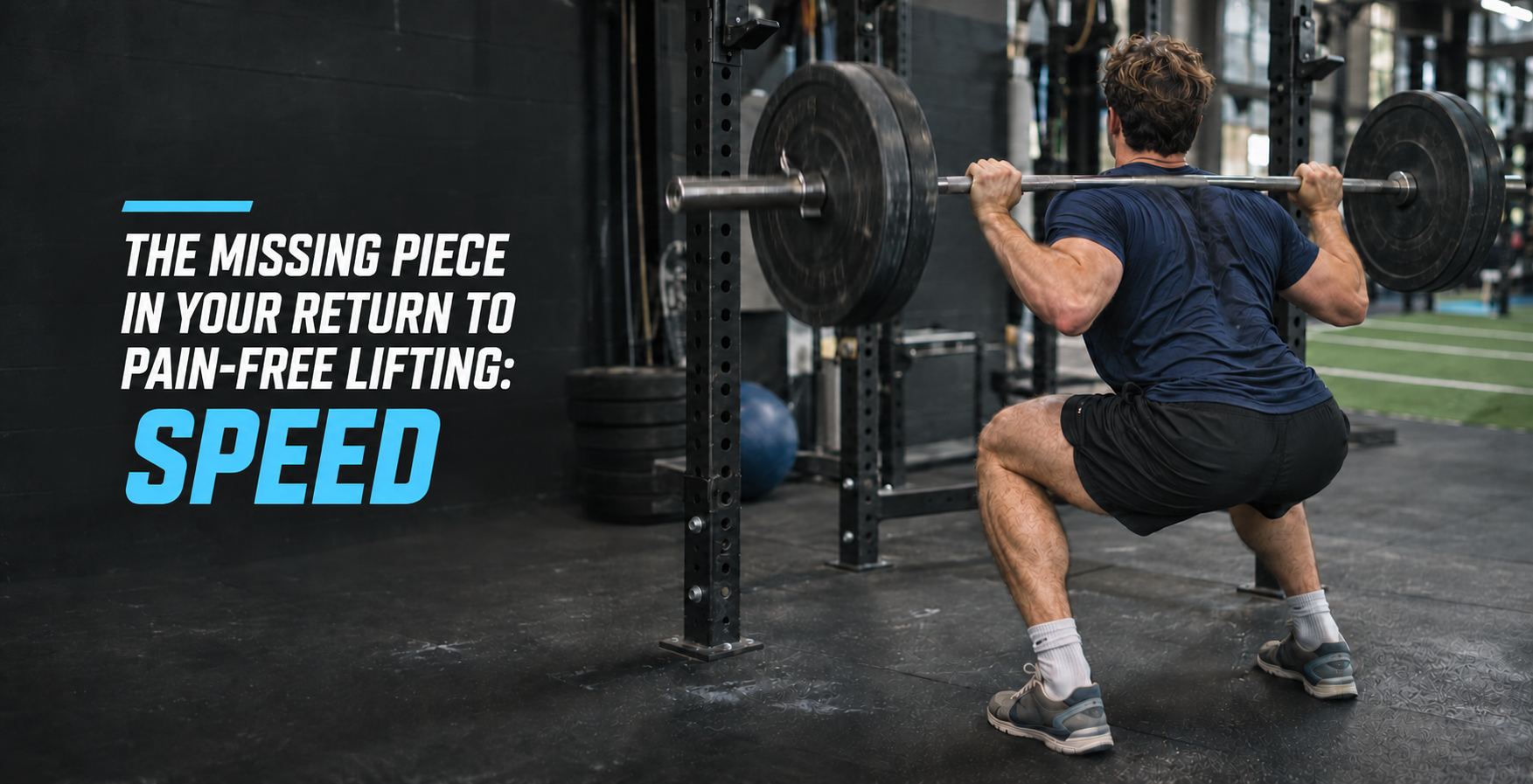
The Missing Piece in Your Return to Pain-Free Lifting: SPEED
Returning to lifts like the squat or deadlift after pain and injury is challenging! Often, the goal is to wait until symptoms calm down, then gradually return to the way you were lifting before…
But there’s an important step that can get overlooked: rebuilding your ability to produce force, not just your ability to tolerate a load.
Many lifters focus on refining technique, choosing a manageable weight, and limiting range of motion or volume to avoid aggravating the area. These are all useful tools! But simply keeping the weight “light” for an arbitrary period of time doesn’t necessarily prepare you for the demands of heavier or faster lifting.
Two variables worth considering: intent and rate of force development.
What is intent?
Movement intent refers to the effort and drive you put into performing a movement. In strength training, this often means consciously trying to move the load as quickly and explosively as you can during the concentric phase, even when the weight itself moves slowly.
For example, when performing a squat with a light, manageable load, you might focus on driving out of the bottom with speed and intent rather than simply standing up at a comfortable pace.
The bar may not move particularly fast, but your effort to accelerate it can still be high.
What is Rate of Force Development?
Rate of force development (RFD) describes how quickly your muscles can generate force.
Outside of how much force you can produce, it’s how quickly you can access and produce that force!!
This matters in training because your body needs to generate force at different speeds and under different demands. Returning to training isn’t going to be the load you’re returning to… it’s also about preparing your muscles and nervous system to produce force efficiently.
Why bar speed and intent matter during a return to lifting
When pain has been present, it’s common to feel guarded around the injured area. You may unconsciously move more slowly, limit how much effort you put into the lift, or avoid certain positions.
That response can be understandable, especially early in recovery. But as symptoms improve, continuing to lift with low effort may leave an important training variable underdeveloped: your ability to produce force.
Using a lighter load with a deliberate, fast concentric intent can help you begin practicing force production without immediately returning to heavy loading.
This gives you a way to challenge the system while still adjusting the variables that matter most: load, range of motion, volume, and movement complexity.
The goal is to choose a variation that feels manageable and then perform it with purposeful intent!
How to incorporate speed into your lifts
You don’t need to jump straight into dynamic or explosive training to benefit from this concept. Start with a lift and range of motion you can tolerate, choose a manageable load, and focus on moving with intent.
For example:
- Squat: Use a box squat or reduced depth if needed. Control the descent, then focus on driving up with speed.
- Band or Chain Squat: put bands or chains on the sides of the bar. When you are at the bottom of the squat, the bar will be the LIGHTEST. As you stand up, the bar has increased resistance to it, so it forces you to accelerate and keep producing force throughout the lift.
- Deadlift: Start from blocks or an elevated position if pulling from the floor is uncomfortable. Set up deliberately, then push through the floor with intent.
- Banded Deadlift: Same concept as the banded squat! This forces power and speed through the lift.
- Bench press: Choose a comfortable range and load, then focus on pressing the bar up quickly while maintaining control.
- Split squat or step-up: Use a variation that feels tolerable and emphasize a purposeful, strong drive through the working leg.
The key is that the exercise should still feel appropriate for your current capacity. If you need to shorten the range of motion, reduce the load, or choose a different variation to make the movement tolerable, do that first.
A simple way to progress
Think of returning to lifting as rebuilding several qualities, not just adding weight.
- Refine the movement. Establish positions and technique that feel controlled and repeatable.
- Add intent. With a manageable load, focus on accelerating through the lifting phase.
- Build volume and load. Gradually increase the training demand as your response and recovery allow.
- Reintroduce higher-demand work. As capacity improves, progress toward heavier loads, faster movements, and the specific demands of your training.
You don’t have to wait until you’re lifting heavy to practice producing force. In fact, using lighter loads to reintroduce intent can be a useful bridge between modified training and your previous program.
What should you pay attention to?
Bar speed is a training variable, not a test you need to pass every session.
Consider how the movement feels during the workout, how your technique holds up, and how symptoms respond afterward. Some discomfort may be acceptable depending on the injury and your clinician’s guidance, but sharp, escalating, or unfamiliar pain is a reason to modify the exercise.
If adding intent causes symptoms to increase beyond what you can comfortably manage, reduce the effort, load, range, or volume—or choose a different variation. Progress should be based on your response, not a rigid timeline.
The takeaway
When returning to lifting after pain, it’s easy to focus entirely on how much weight you’re lifting. But load is only one part of the equation.
Movement intent and rate of force development help address another important question: Can you produce force confidently and efficiently?
Starting with a manageable load and emphasizing purposeful acceleration can be a valuable way to rebuild that ability before returning to heavier training. Rather than simply waiting for pain to settle and then picking up where you left off, you can use the return-to-lifting process to progressively rebuild the qualities your training requires.
Don’t just work back toward lifting more weight. Work toward producing force with confidence.

Written by Dr. Jessie Czarnecki, PT, DPT, OCS, CSCS, Cert. DN | Physio Room
Connect with Physio Room:
Find Us On Our Socials
Website
Instagram
Facebook